AI Arcade — 1

Hey guys! Welcome to AI Arcade. This AI Arcade is in building phase, but it will turn everyday stuff into awesome power-ups.
I am sure you are not the only one who is astonished by the growth that AI has made in recent years. By reading and watching the news daily you might think, “What really is an AI and how it is shaping our future?”
AI is literally everywhere! No, it’s not just ChatGPT; whenever I speak of AI people usually gives these 2 words that is ChatGPT and a robot doing everything by its own. (IkIk ChatGPT 4o is released and it is doing tremendously good and cool stuff) but its deeper and broader that one can even imagine.
Before going into the deeper insights, let’s all give some real-life examples (ofc except ChatGPT and bard) where AI plays a major role. Let me list some, and your go into the comment section and list many! Spotify or Netflix recommending you songs and web series according to your watch time and interest
AI is not just about mimicking humans but it’s about machines learning from experience and adjusting itself according to the training. It automates the tasks that once required human intervention, from voice assistants to self-driving cars.
What is the definition of AI?
a particular computer system or machine that has some of the qualities that the human brain has, such as the ability to interpret and produce language in a way that seems human, recognize or create images, solve problems, and learn from data supplied to it. But what does that exactly mean?
It’s like teaching a small child about what is a dog. You show them different pictures of dog with different breeds and from some point that child can now figure out that where the picture is really a dog or not by figuring out some common characteristics.
How AI Learns?
AI learns by eating information! It eats up tons of data, like facts and numbers, from all sorts of places. But before it can use this data, it needs a little cleaning up (data preprocessing & normalization), just like sorting your study table before you sit for actual study.
Then comes the learning part. AI algorithms use this data to learn patterns and relationships. It’s like studying for a test. Some algorithms learn through trial and error, like getting rewarded for correct answers (reinforcement) or penalized for mistakes (punishment). This constant learning and improvement allow AI to become more effective over time.
The more data AI has, the better it can understand patterns and make smarter decisions. The vast amount of data, also know as big data, undergoes various types of algorithms like linear regression, logistic regression, K-means clustering, Associative rules, Apache framework, Mapreduce framework etc. Now, this is deep, every algorithm has loads of mathematical calculations and its not possible to go in deep for every algorithm. For now, just remember the names.
How AI is different from traditional computing?
In traditional computing, the model relies on explicit programming, it is trained over and over again to perform a specific task with predefined set of rules. Whereas AI learns from large data sets, identifies patterns and relationships, and gets better and better over the time.

Machine learning & Deep Learning
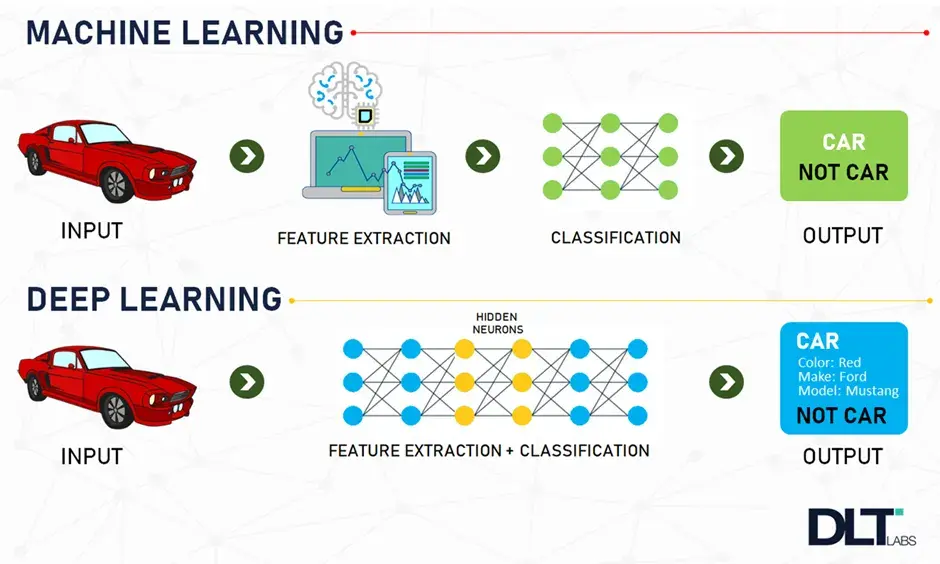
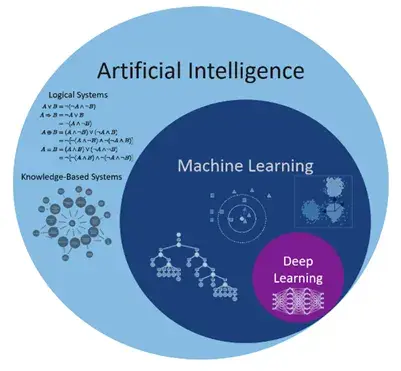
Generally, people use deep learning, machine learning and AI interchangeably. But its NOT the same. AI is divided into 2 sub fields that is machine learning and deep learning.
Machine Learning:
Machine learning is a branch of artificial intelligence (AI) that focuses on algorithms’ ability to learn from data. These algorithms can identify patterns and relationships within the data, enabling them to make predictions or decisions without being explicitly programmed for every situation.
Supervised Learning: Learns from labelled data where the desired output is known. Examples: Linear Regression (prediction), Decision Trees (classification).
Unsupervised Learning: Identifies patterns in unlabeled data without predetermined outcomes (e.g., clustering customers based on purchasing habits). Examples: K-means Clustering, Principal Component Analysis.
Reinforcement Learning: Learns through trial and error, receiving rewards for successful actions and penalties for failures (e.g., AI playing games and adapting strategies). Examples: Q-Learning, Policy Gradient.
Ensemble Learning: Combines multiple weaker models to create a more robust and accurate predictor. Examples: Random Forest using multiple decision trees.
Dimensionality Reduction: Reduces the number of features in a dataset while preserving important information
Deep Learning:
Deep learning is a subfield of machine learning that utilizes artificial neural networks (ANNs) with multiple layers to process information. These networks are loosely inspired by the structure and function of the human brain.
Convolutional Neural Networks (CNNs): Specialized for image recognition and analysis, exploiting the spatial relationships between pixels (e.g., object detection, image classification).
Recurrent Neural Networks (RNNs): Handle sequential data like text or speech, processing information step-by-step and maintaining a memory of past inputs (e.g., machine translation, sentiment analysis).
Generative Adversarial Networks (GANs): Consist of two competing neural networks: a generator that creates new data, and a discriminator that tries to distinguish real data from generated data (e.g., generating realistic images, creating new music styles).
Autoencoders: They learn to compress data into a smaller, more manageable form while preserving key information. (e.g., anomaly detection, image denoising).
Transformers: They can analyze long sentences and capture the relationships between words, regardless of their position, leading to more accurate and nuanced understanding of language. (e.g., machine translation, text summarization).
AI isn’t about creating machines that think exactly like humans. Instead, it’s about building efficient algorithms that can solve problems and improve processes. AI consumes mountains of data and an learns from it. Then this learning is applied in our lives to make it easier and smooth. It can be anything like predicting a series from your behavior or predicting traffic on the road or solving any math’s problem or detecting potential health issue or generating an image from the prompt.
AI is just more than the buzzword.
AI in Day-to-Day Life
Shopping: AI can suggest outfits based on your style, and even let you virtually try them on!
Music: AI helps you discover music you’ll love and can even help you create your own songs.
Healthcare: AI can help detect diseases early and personalize treatment plans.
Transportation: Self-driving cars powered by AI can navigate traffic and avoid accidents.
Finance: AI helps track financial risks, suggest investments, and detect fraud.
AI in Cyber Security
Threat Detection & Prevention: Network traffic and user behavior analysis can be performed by AI and it can even identify hidden patterns and anomalies.
Automated Response: AI can be used to automate actions against threats, like blocking suspicious login attempts.
Phishing & Malware Detection: Emails & websites can be analysed to identify phishing attempts and malware.
Vulnerability Management: AI can scan systems, networks, devices or websites for weaknesses and can suggest patching them.
Continuous Learning & Improvement: AI algorithms are made in such a way that it learns continuously. So, this learning and improvement with new threats can be lead to better results.
Ethical considerations
This amazing technology brings lots of concerns, challenges and ethical considerations that must be thoughtfully addressed.
Privacy Concerns: AI algorithm depends on our data, but its use and protection should be maintained.
Misinformation and Deepfakes: AI can create fake videos or audios called deepfakes. Read more about deepfakes here.
Job Displacement: AI automation could lead to job loss, if an only if you don’t update & adapt yourself with new technology. This is a topic to debate but you have to make sure that you learn how to use AI correctly and ethically.
Bias in AI: AI algorithms can cause biases from the data they’re trained on. (Structured & Unstructured data has different impact on the algorithms).
Accountability & Control: Who’s responsible for AI decisions? This is a major question which leads to accountability issues.
That’s all for this week on AI! (I know you guys have a lot to say about it). This is just the first chapter, though. I would love to hear your thoughts and interesting facts. So, do share your reviews! Claps always appreciated!
See you next Thursday, till then go jump into using different AI!


Comments