SCADA Essentials: RTUs, HMIs, and Smart Systems
- Aastha Thakker
- Oct 29, 2025
- 4 min read


In the previous blog, we discussed the basics of SCADA, including its importance and architectural framework. This blog shifts the focus to key components such as Remote Terminal Units (RTUs), Human-Machine Interfaces (HMIs), and Intelligent devices. Additionally, we’ll examine the roles of data loggers and Intelligent Electronic Devices (IEDs) in SCADA and IoT systems.
What Exactly is an RTU?
Often referred to as remote telemetry or telecontrol units, these devices excel in gathering telemetry data and remotely controlling equipment.
RTUs gather both analog and digital data from sensors and meters, monitoring key industrial process variables like temperature, fluid levels, equipment speed, position, and security status. This data is then transmitted to a centralized system for monitoring and control. Essentially, RTUs compile information from various field devices and relay it to the central SCADA system, facilitating effective monitoring of physical conditions.
The hardware of an RTU includes setup software to connect data output streams, communication protocols, and built-in troubleshooting tools. They are usually powered by alternating current (AC) mains with direct current (DC) converters and often have a battery backup to ensure uninterrupted operation. RTUs are particularly suited for industrial operations in remote or harsh environments characterized by high temperatures, chemical exposure, vibrations, dust, or pressure, where other controllers like programmable logic controllers (PLCs) may not perform reliably.
Breaking Down the RTU Components
Central Processing Unit (CPU):
At the core of an RTU lies its CPU, equipped with modern 32-bit microprocessors that handle complex tasks effortlessly. These CPUs often include Ethernet communication ports and sometimes come in dual setups, providing redundancy to ensure zero downtime. Whether it’s ladder logic programming or advanced coding in C#, these CPUs have you covered.
Power Supply:
Continuous power? Check. Backup batteries? Absolutely. RTUs are built to operate in remote areas where reliability isn’t just a feature — it’s a necessity.
Communication Ports:
Communication is king in automation, and RTUs don’t disappoint. Whether it’s Ethernet, RS-232, or Modbus, these devices ensure seamless data exchange with SCADA systems. Their support for diverse network topologies (star, ring, series) makes them incredibly versatile.
Physical Input/Output (I/O):
RTUs are packed with input/output modules to interact with field devices. Digital I/Os handle status and commands, while analog I/Os manage variable data like voltage and current.
HMIs
Human-machine interfaces(HMIs) are user-friendly tools that connect operators with industrial machinery and systems. They combine hardware like touchscreens and I/O modules with software to enable real-time monitoring, control, and data visualization. Operators interact with HMIs through intuitive visual interfaces to input commands, receive feedback, and make decisions.
Key Components:
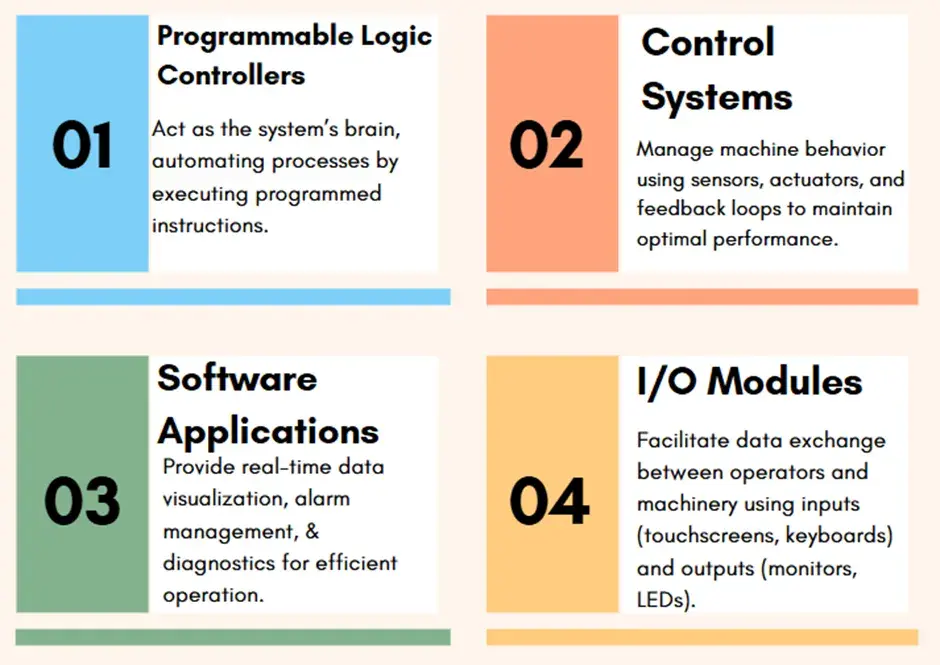
Types of HMIs:
Graphical User Interfaces (GUIs): Use icons, buttons, and graphics for easy interaction, simplifying tasks like monitoring and troubleshooting.
Touchscreens: Allow direct interaction through taps and swipes, ideal for real-time control and visualization.
Capacitive Touchscreens: Detect touch via electrical charge, common in smartphones.
Resistive Touchscreens: Use pressure detection, perfect for rugged environments like factories.
3. Web-Based HMIs: Enable remote access to systems from any internet-connected device, supporting tasks like adjusting settings or scheduling maintenance.
Benefits of HMIs
Ease of Operation: HMIs simplify complex processes with intuitive interfaces, making system control and monitoring easier.
Real-Time Monitoring: Provide instant data updates, enabling quick decision-making and efficient system management.
Improved Efficiency: Automate processes and reduce human error, optimizing productivity and operational workflows.
Remote Access: Allow operators to control and monitor systems from anywhere using web-based interfaces.
Enhanced Safety: Deliver timely alerts and visual feedback to prevent equipment failures and ensure safe operations.
Data Loggers
Data loggers are compact electronic devices designed to record and store data over time. Resembling small boxes, they typically house a power source (batteries), microprocessors, internal memory, sensors, and a programmable module. Once connected to sensors, data loggers capture and store data at regular intervals in their non-volatile memory. These devices are especially valuable for monitoring structures or systems, where predefined alert levels can be set. If recorded data exceeds these thresholds, the data logger can automatically send emergency alerts via email or SMS, enabling timely preventive action to avoid potential mishaps or accidents.

Intelligent Electronic Devices (IEDs)
Intelligent Electronic Devices (IEDs) are sophisticated hardware components widely used in industrial and utility environments, especially within electrical power systems. These devices are designed to monitor, control, and automate various processes. Equipped with microprocessors, communication capabilities, and advanced software, IEDs are far more capable than traditional devices.
Key Functions of IEDs:
Data Collection: Gather critical data from sensors and equipment, such as voltage, current, temperature, and pressure.
Monitoring: Continuously track the operational status of equipment like circuit breakers, transformers, and generators, detecting faults or abnormal conditions.
Control: Send commands to adjust or operate equipment automatically, such as opening or closing circuit breakers to safeguard power systems.
Automation: Perform tasks autonomously, including controlling electricity flow or switching systems based on predefined rules.
Communication: Enable seamless interaction with other IEDs and systems using standardized protocols, such as IEC 61850, for remote monitoring and control.
See you next Thursday with some more insights on communication protocols.


Comments