SCADA Simplified: Connecting IoT & SCADA
- Aastha Thakker
- Oct 29, 2025
- 3 min read


Supervisory Control and Data Acquisition (SCADA) is a sophisticated system designed to provide comprehensive monitoring, control, and management of industrial processes. It serves as the central nervous system of industrial operations, collecting and analyzing data from various field devices and enabling real-time decision-making. The system consists of both software and hardware components and enables remote and on-site gathering of data from the industrial equipment.
SCADA Workflow (Simplified)
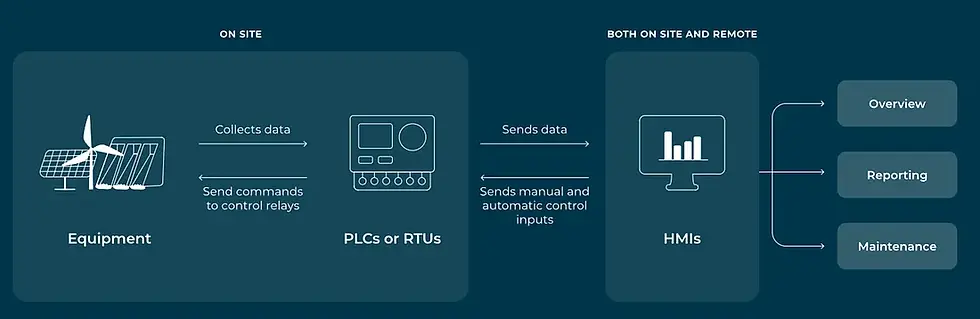
Equipment (On-Site):
This includes field devices like turbines or solar panels. These devices collect data about processes (e.g., temperature, pressure) and send it to controllers. They also receive commands to perform actions like turning on/off or adjusting operations.
PLCs or RTUs (On-Site Controllers):
Programmable Logic Controllers (PLCs) or Remote Terminal Units (RTUs) are used to process the data collected by equipment. They make decisions locally (like turning on a pump) and send data to the next level for further monitoring or adjustments.
HMIs (On-Site or Remote):
Human-Machine Interfaces (HMIs) are systems that display the data received from controllers in a user-friendly format. They allow operators to monitor the system, generate reports, and perform maintenance tasks either on-site or remotely.
Outputs:
The information processed by HMIs is used for three main purposes:
* Overview: Gives operators a clear picture of the system’s performance.
* Reporting: Provides detailed insights and logs of operations.
* Maintenance: Helps in identifying issues and managing system upkeep efficiently.
Components of SCADA
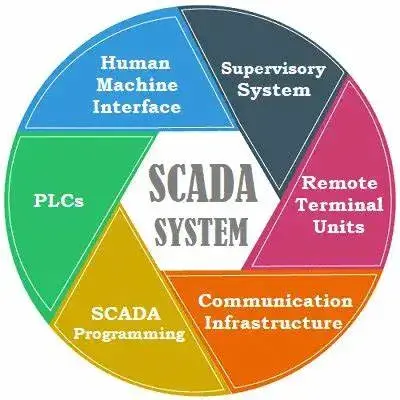
. Sensors and Actuators: The Data Collection Pioneers
Sensors: Sophisticated electronic devices that transform physical phenomena into measurable electrical signals. Measure critical parameters like temperature, pressure, humidity, and flow rates.
Provide continuous, real-time data streams
Actuators: Electromechanical devices that convert electrical signals into physical actions.
Execute control commands such as opening valves, adjusting motor speeds, or triggering alarms.
Ensure precise and immediate response to system requirements
2. Field Controllers: The Intelligence at the Edge
Remote Terminal Units (RTUs)
Collect telemetry data from distributed sensors
Process local data and communicate with central systems
Operate in challenging industrial environments with robust design
Programmable Logic Controllers (PLCs)
Provide real-time control of specific industrial processes
Implement complex logic and sequential control strategies
Highly adaptable to various industrial applications
3. Supervisory Computers: The Central Command
Centralized systems that aggregate and analyze data from field controllers
Implement advanced algorithms for process optimization
Enable comprehensive visualization and control of industrial systems
4. Human-Machine Interface (HMI): Bridging Technology and Human Insight
Intuitive graphical interfaces displaying real-time process information
Allow operators to monitor, control, and adjust industrial processes
Support decision-making through interactive dashboards and alerts
5. Communication Infrastructure: The Connectivity Backbone
Utilize diverse communication protocols (Modbus, Ethernet, wireless technologies)
Ensure reliable and secure data transmission
Support both wired and wireless communication architectures.'
SCADA Architecture
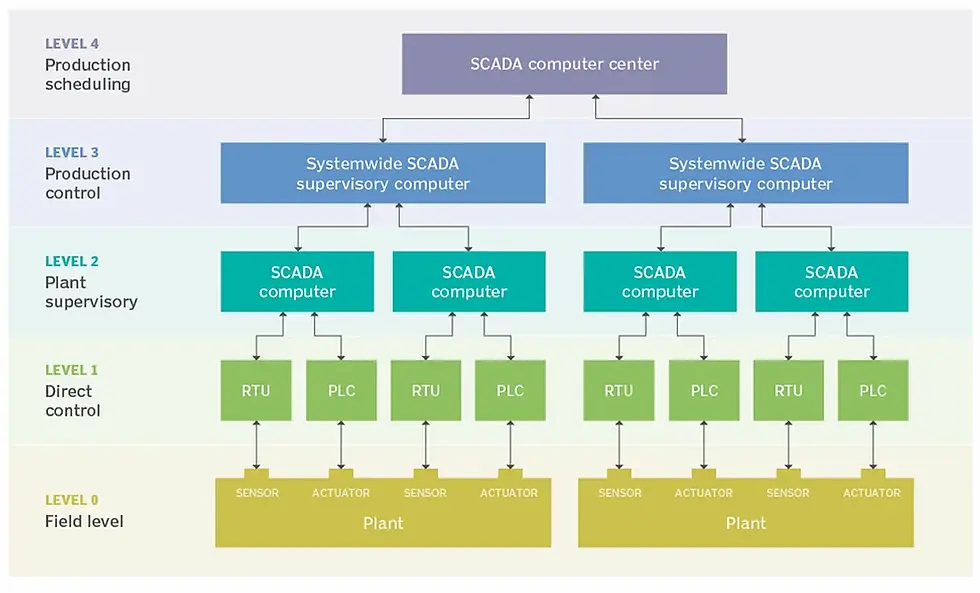
Level 0 (Field Level): This is where sensors and actuators interact directly with physical processes. Sensors collect data like temperature or pressure, while actuators control actions such as opening valves or starting machines.
Level 1 (Direct Control): Local controllers like PLCs and RTUs manage the data from sensors and send commands to actuators, ensuring real-time process control.
Level 2 (Plant Supervisory): Systems like SCADA and HMIs supervise multiple controllers, aggregate their data, and provide operators with insights for localized monitoring and adjustments.
Level 3 (Production Control): This level integrates data from the plant supervisory systems to manage site-wide operations, generate reports, and issue alerts, and support decision-making for production efficiency.
Level 4 (Production Scheduling): At the top, business systems handle production planning, resource allocation, and overall scheduling based on data from lower levels, aligning processes with organizational goals.
IoT: Taking SCADA to the Next Level
While SCADA excels in control and monitoring, IoT introduces smarter connectivity, predictive analytics, and real-time collaboration. When paired, these technologies amplify each other’s capabilities.
Why SCADA + IoT = Industrial Future?
1. Remote Control: Manage from Anywhere
Imagine troubleshooting a remote wind farm without leaving your desk.
With SCADA and IoT, operators have the freedom to access systems globally, slashing downtime and travel costs.
2. Enhanced Safety: Real-Time Protections
Monitor hazardous conditions like high pressure or temperature in chemical plants.
Early warnings prevent disasters, protecting both lives and infrastructure.
3. Unmatched Efficiency: Automating the Future
Automated systems detect inefficiencies and recommend real-time optimizations.
Example: Smart energy management in factories reduces both consumption and costs.
4. Scalability and Customization: Tailored for Growth
Whether you’re expanding operations or adopting new machinery, SCADA and IoT adapt seamlessly.
Custom interfaces ensure your unique requirements are always met.
Evolution of SCADA: From Monolithic to Modern
First Generation — Monolithic Systems: Standalone, mainframe-based systems with limited networking.
Second Generation — Distributed Systems: LAN-based systems enabling interconnectivity.
Third Generation — Networked Systems: WAN capabilities and open architecture with internet protocols like IP.
Keeping this blog short and sweet as my external exams are in the middle. Wish me luck, and good luck to you too!
I’ll see you next Thursday with more updates.


Comments