Artificial Urgency

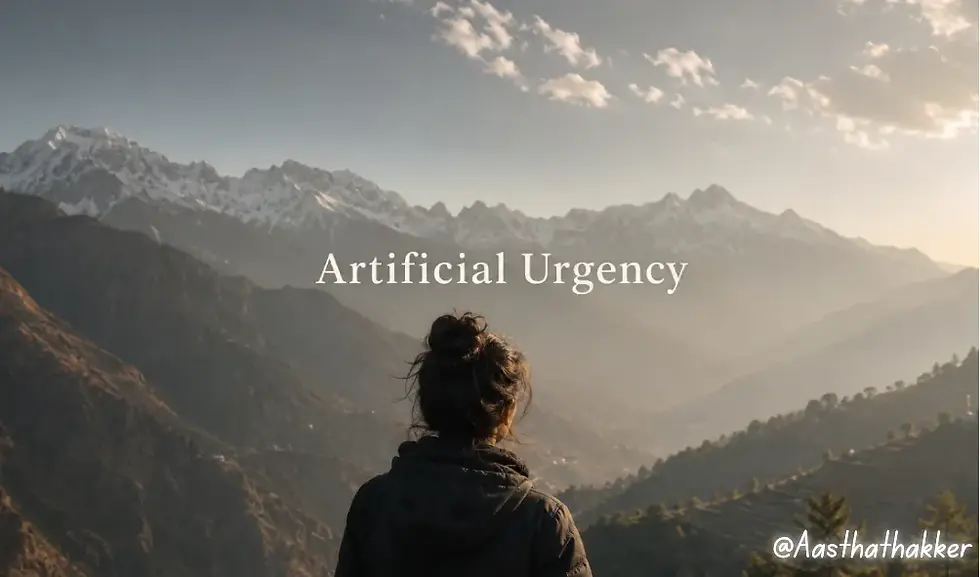
Back from 15 days in Spiti, no Wi-Fi and high-altitude
So, Spiti. Fifteen days. Laptop physically shut the entire time, two posts pre-scheduled so Thursdays stayed intact, and a deliberate decision to not open any tab that required thinking.
A heads-up if you’re planning the trip: Spiti is not a cute little drive you do over a long weekend. Some stretches have roads. Some stretches have the general concept of roads. Some stretches are just mountain terrain your vehicle is quietly negotiating with. One of the most extraordinary places I have ever been. Go but go prepared.
Our group was having wide range of humans: a five-year-old with limitless energy, students who’d just finished their boards, a doctor, couples, solo travelers, people in their forties and fifties who were, frankly, handling the altitude better than the rest of us. Different cities, different jobs, completely different lives.
I didn’t expect any of them to hand me the topic for this week’s post. But somewhere between a mountain pass and a dead zone, they did.
At some point during the day, someone’s phone would ring. And almost every time, the conversation started with the same phrase: “Sorry to disturb you, but this is urgent.” The interesting part was that the “urgent” task was rarely an emergency.
A document needed reviewing.
A message needed drafting.
A presentation needed updating.
Someone needed a quick answer. Someone needed something generated with AI. Someone needed “just five minutes.”
One person stepped away from a viewpoint of Kinnaur Gate to take a call about a presentation deck. They were back in eight minutes. The viewpoint was gone; we’d moved on. I don’t think they noticed for a while.
If you are in a leadership or management role, if someone has formally applied for leave, received approval, and is mid-trip, please consider whether what you are calling them about is genuinely an emergency.
Now, genuine emergencies absolutely exist. If you’re a doctor, handling a critical incident, or responsible for something that genuinely cannot wait, that is a completely different discussion.
But most of what I observed was not urgency. It was expectation disguised as urgency.
Every single call carried the same logic underneath it.
A few years ago, many tasks naturally came with a delay. Writing required time. Research required effort. Drafting ideas required thinking. People understood that certain things simply could not be produced instantly.
Today, AI has changed that equation.
If an email can be drafted in thirty seconds, people begin expecting it in thirty seconds.
If a report can be summarized in a minute, suddenly a one-hour turnaround feels slow.
If information is available immediately, patience quietly disappears from the process.

AI doesn’t get tired between requests. It doesn’t carry the mental residue of the previous task. Every prompt begins with a clean slate. They are stateless. From a pure compute standpoint, a five-minute task is genuinely five minutes, every single time.
The problem is that humans are not stateless systems. Neuroscience has a specific name for what happens when you interrupt a mental state, whether it is rest, deep work, or standing at 14,000 feet trying to actually be present, it is called attention residue. The task is done in five minutes.
The cognitive reloading cost does not show up on any dashboard.
Decision Overhead
AI did not remove effort from the loop. It added a decision before every output.
Before AI, writing an email involved one decision: send it or don’t. Now there are five. Write it yourself, ask AI, compare versions, refine the prompt, improve the result. The task became easier, but the decision tree became larger.
Now there is an additional branch in that loop: should I run this through AI first? Use it. Don’t. Use it, compare both versions, tweak the prompt, run it again. None of these steps are technically hard but in decision theory, every additional choice point carries a processing cost. AI did not reduce cognitive load at the output stage. It inserted a micro-decision before every single output that did not exist before.
Someone on the trip spent twenty minutes deciding whether to write a response themselves or use AI to draft it first. The response took five minutes once they started. The decision about the response took four times longer. That gap doesn’t appear on any productivity dashboard. Nobody measures it. But it accumulates across every task, every day, quietly.
Definition of “good enough”
Before capable generative models became daily tools, “good enough” was a legitimate finishing state. The thing communicated what it needed to. You shipped it. The loop closed.
Now a background process runs at all times: if a model could have made this sharper in thirty seconds, why didn’t I? The finishing line moved, not because anyone updated the standard but because the capability ceiling got raised and human psychology adjusted the internal baseline upward to match.
AI made improvement feel infinite. And humans, historically, are not built for infinity.
No Network?
During the trip, I noticed something else.
The only place where nobody talked about deadlines, urgent tasks, AI tools, or pending messages was Chandratal. Not because people suddenly became enlightened. There was simply no network. For a few hours, nobody could respond. Nobody could optimize.
Nobody could be available. And somehow the world continued functioning perfectly fine.
I caught myself doing it on the drive back. Signal returned somewhere before Kaza and the first thing I did, before checking on anyone, before anything, was open messages to see if something had gone wrong while I was unreachable.
Nothing had.
I’ve been thinking about that moment more than anything else from the trip.
Maybe the real problem is our inability to define what is actually important.
We keep optimizing because optimization is possible. We keep improving because improvement is available. We keep responding because response is expected.
Somewhere between productivity and convenience, we accidentally created a culture where everything feels urgent.
The mountains reminded me of something simple.

Not every notification deserves immediate attention.
Not every task is a crisis.
And not every problem needs a faster solution.
Sometimes the best thing you can do is close the laptop, look around, and realize that the world is capable of waiting a little longer than we think.
The question isn’t whether AI saves time. The question is what we choose to do with the time it saves. Because if every efficiency gain simply becomes an excuse to add more work, then maybe we were never chasing productivity in the first place.
Maybe we were just finding more sophisticated ways to stay busy.
So, what’s the point of writing this non-technical blog?
Because nobody writes about the viewpoint you missed while drafting a slide deck at 14,000 feet.
AI is getting faster. Deadlines are getting shorter. Expectations are quietly becoming non-negotiable. And somewhere in that loop, we forgot to ask the only question that actually matters, urgent for whom, exactly?
The mountains don’t care about your turnaround time. Neither should you, at least once in a while.
Close the tab. The summary can wait.


Comments