You Saw "Merkle Root" in a Block Explorer. But What Is It?


If you have read my previous blog, “Blockchain Explorers: What’s Actually Happening On-Chain,” you might remember that while exploring a block, we came across a field called Merkle Root.
At first, it looks like just another long string of letters and numbers in the block details. What is this hash actually telling us?
We already know that a block can contain hundreds or thousands of transactions. So, how does the blockchain keep track of all those transactions in a way that is both efficient and easy to verify? Of course, the previous-block hash links one block to the next. But here is another question: if a transaction inside the 5th block is modified, how does that change become visible through the rest of the blockchain?
Transaction changes
        ↓
Transaction Hash changes
        ↓
Merkle Root changes
        ↓
Block Hash changes
        ↓
Next Block's Previous Hash no longer matches
        ↓
The chain becomes inconsistent
This is where Merkle Trees come in.
A Merkle Tree takes the hashes of individual transactions, combines them in pairs, and keeps hashing those pairs until only one hash is left. That final hash is the Merkle Root. Short but important concept.
With a Merkle Tree, the blockchain can prove that a particular transaction belongs to a block without having to check every other transaction in that block.
What is a Merkle Tree?
A Merkle Tree is a hash-based data structure that represents a large
collection of data with a single value called the Merkle Root.
Data → Hashes → Pair the hashes → Hash again → Repeat → Merkle Root

Every parent depends on the hashes below it. Change one transaction, and its hash changes, its parent changes, and eventually the Merkle Root changes.
The biggest advantage of a Merkle Tree is that you don’t have to verify every transaction inside a block. Instead, you only need a few hashes that connect your transaction to the Merkle Root. These hashes are called a Merkle Proof.
Think of 1,000 transactions in a block. To prove that one transaction belongs to that block, you don’t need all 1,000 transaction hashes. You only need the hashes along the path from that transaction to the Merkle Root. By combining and hashing these values, you can recreate the same Merkle Root stored in the block header. If both roots match, the transaction is confirmed to be part of the block. Because only a small number of hashes are required, verification becomes much faster and uses less storage and bandwidth. This is exactly how Simplified Payment Verification (SPV) wallets work, they can verify transactions without downloading the entire blockchain. As described in ‘Bitcoin’.
If there is an odd number of hashes at a level, Bitcoin duplicates the final hash so that the hashes can still be paired.
Technically, the proof size grows logarithmically (O(log n)), which means even if a block contains thousands of transactions, only a small number of hashes are needed for verification.
Where the Merkle Root Lives
In Bitcoin, the Merkle Root sits inside the block header, alongside the previous block hash, timestamp, difficulty target, and nonce.

So that tree is built by a miner, they work out the root, and that root is included in the header which is used during Proof of Work. (Bitcoin) If a transaction is changed on retrospect-then the change propagates; transaction hash > parent hash > Merkle Root > block header > block hash. That’s the tamper-evident property.
Merkle Proof in Practice
Suppose a block has 1,024 transactions and you want to verify just one of them. You don’t need to check all 1,024 transactions. You only need the sibling hashes along its path to the Merkle Root. Since 2¹⁰ = 1,024, only about 10 hashes are needed. (log₂(1024) = 10)
The verifier combines these hashes step by step and checks whether the final result matches the Merkle Root in the block header.
If they match, the transaction is part of that block. That’s the main reason Merkle Proofs are useful: less data, less computation, and much faster verification.
1 level → 2 transactions
2 levels → 4 transactions
3 levels → 8 transactions
4 levels → 16 transactions
...
10 levels → 1,024 transactions
Try It Yourself
Bitcoin Merkle Tree Visualizer and Merkle Tree Explorer both let you build a tree, pick a leaf, and check its proof path. Build a 4-transaction tree, note the root, change one transaction, rebuild, watch the root change.

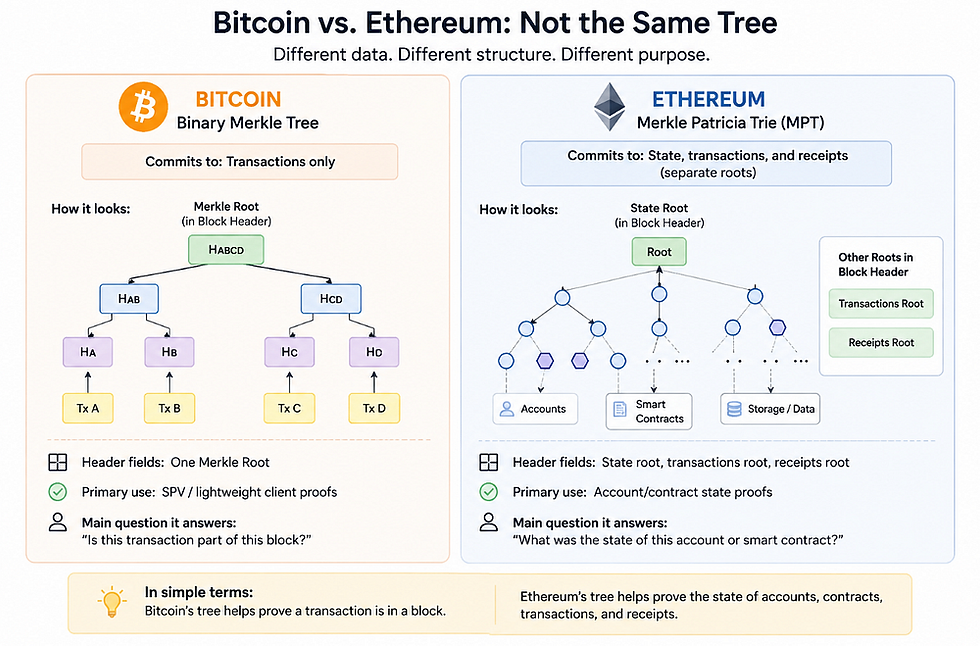
Bitcoin vs. Ethereum: Not the Same Tree
It is important to note that Bitcoin and Ethereum don’t use Merkle Trees in exactly the same way. Bitcoin uses a traditional binary Merkle Tree mainly to organize and verify the transactions inside a block. Its Merkle Root is stored in the block header and helps lightweight clients verify transaction inclusion. Ethereum uses a more advanced structure called a Merkle Patricia Trie (MPT). Instead of only representing transactions, Ethereum uses separate roots to represent things such as account and smart contract state, transactions, and receipts.
One Concept to Remember
A Merkle Tree is the structure. A Merkle Root is the final hash it produces. A Merkle Proof is the evidence that a piece of data belongs to that structure. Once these three click, block headers, SPV wallets, and state proofs all get easier to reason about.
Resources
Bitcoin Whitepaper: SPV and Merkle branches. (Bitcoin)
Bitcoin Developer Reference; Merkle blocks and P2P protocol. (Bitcoin Developer Documentation)
Ethereum Documentation: Merkle Patricia Trie. (ethereum.org)
Ralph Merkle’s original patent on authentication trees. (patents.google.com)


Comments